
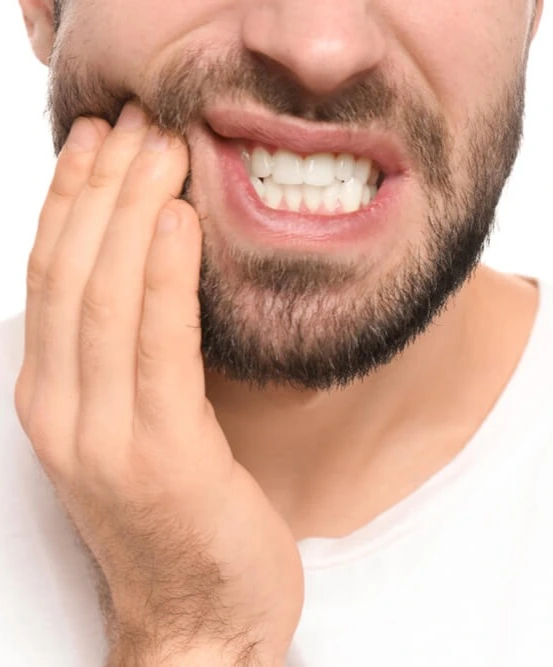
Why Does My Tooth Hurt When I Bite Down?
One of the most common things patients tell me is:
“Doctor, my tooth doesn’t really hurt all the time, but it hurts when I bite down.”
Pain when biting can be frustrating because it may seem like there is nothing obviously wrong with the tooth.
But pain when biting is not a diagnosis by itself.
There are several possible causes, including a cracked tooth, a high filling or crown, inflammation around the root, periodontal problems, or excessive forces from bruxism.
The important thing is to determine where the pain is coming from and why it is happening before deciding on treatment.
What Causes Pain When Biting Down?
Some of the most common causes include:
- Endodontic or periapical problems
- A high filling or crown
- Cracked or fractured teeth
- Bruxism and excessive biting forces
- Periodontal problems
- Recent dental treatment
- Advanced decay or structural damage
Let’s look at the main causes.
1. A High Filling or Crown
If you recently had a filling or crown placed and the tooth starts hurting when you bite, one of the first things we need to evaluate is the occlusion.
If a restoration is slightly too high, the tooth may receive excessive pressure every time you close your mouth.
This can lead to tenderness and inflammation around the tooth.
However, I don’t automatically assume that every tooth that hurts after a filling or crown has a high bite.
I first look at the patient’s history and symptoms, then evaluate the occlusion and the tooth itself.
If the restoration is indeed high, a simple occlusal adjustment may be enough to resolve the problem.
This is an important distinction because pain after a filling or crown does not automatically mean that the tooth needs a root canal.
2. A Cracked or Fractured Tooth
A cracked tooth is another important cause of pain when biting.
Patients may describe:
- Sharp pain when biting
- Pain when releasing the bite
- Difficulty identifying exactly which tooth hurts
- Sensitivity to cold
- Pain that comes and goes
- A history of large fillings
- Repeated fractures of the same tooth
- A history of bruxism
One particularly useful clinical clue is pain when releasing the bite.
This can make us more suspicious of a crack, although it is important to understand that this symptom alone does not diagnose a cracked tooth.
When I suspect a crack, I perform multiple clinical tests to determine its direction, location, depth, and extent.
A crack can be horizontal, vertical, superficial, deep, or extend below the gum.
The prognosis depends heavily on these factors.
A vertical fracture extending below the gum or into the root can have a poor prognosis, while other fractures may be restorable.
So hearing the words “you have a cracked tooth” does not automatically mean the tooth needs to be extracted.
The type of crack matters.
3. Endodontic or Periapical Problems
Pain when biting can also come from inflammation around the root of a tooth.
This can happen when the dental pulp becomes inflamed or infected, or when inflammation develops around the root.
Some symptoms that can make us suspicious of an endodontic problem include:
- Spontaneous pain
- Lingering sensitivity to hot or cold
- Pain when biting
- Pain on percussion
- A history of deep decay
- Previous trauma
- A previous root canal
- Swelling
- A gum fistula or “pimple” near the tooth
In these situations, we don’t diagnose the problem based on one symptom.
I may use pulp vitality testing, percussion, clinical examination, dental X-rays, and CBCT when indicated to understand what is happening.
Only after establishing the diagnosis can we decide whether endodontic treatment is necessary.
4. Periodontal Problems
Not every tooth that hurts when biting has a problem inside the tooth.
Sometimes the problem comes from the supporting tissues around the tooth.
Periodontal inflammation, a localized deep periodontal pocket, or a periodontal abscess can cause tenderness when biting.
This is why a periodontal examination can be just as important as examining the tooth itself.
I may evaluate:
- Probing depths
- Bleeding and inflammation
- Localized periodontal pockets
- Tooth mobility
- Bone levels
- The surrounding gum tissues
If the source of the pain is periodontal, treating the periodontal problem may resolve the symptoms without any need for root canal treatment.
Again, the treatment depends on the diagnosis.
5. Bruxism and Excessive Biting Forces
Bruxism can also cause pain when biting.
Patients who clench or grind their teeth can place excessive forces on their teeth and supporting tissues.
Sometimes this produces obvious cracks or tooth wear.
Other times, the tooth may look relatively normal but the excessive forces can still contribute to tenderness and inflammation.
When I suspect bruxism, I look for signs such as:
- Tooth wear
- Flattened or damaged cusps
- Fractures
- Muscle tenderness
- Repeated restoration failures
- Signs of excessive occlusal forces
- A history of clenching or grinding
The goal isn’t simply to treat the painful tooth.
We also need to understand and control the forces affecting it.
I generally start by discussing habits and contributing factors with the patient. If necessary, a properly designed night guard can be used to help protect the teeth.
Because if the excessive forces continue, simply repairing the tooth may not solve the underlying problem.
Why Does My Tooth Hurt When I Release My Bite?
This is a question I hear frequently.
Pain that occurs particularly when releasing the bite can sometimes make us suspicious of a cracked tooth.
The reason is that a crack can allow part of the tooth to flex under pressure and then move as the bite is released.
However, this is only a clinical clue, not a diagnosis.
Other problems can produce similar symptoms, which is why we need to combine the patient’s history with clinical examination and appropriate diagnostic tests.
Why Does My Tooth Hurt After a Filling?
Some sensitivity or tenderness after a filling can be temporary.
However, if the tooth hurts significantly when you bite, one of the first things I want to evaluate is the occlusion.
A restoration that is slightly high can place excessive pressure on the tooth.
But the history matters.
If the tooth already had deep decay, if the restoration was very deep, or if there were symptoms before treatment, we also need to consider other possible causes.
That’s why I don’t automatically assume that the filling is the problem.
We investigate first.
Why Does My Tooth Hurt After a Crown?
The same principle applies after a crown.
A crown that is slightly high can create excessive occlusal contact and cause discomfort when biting.
But pain after a crown can also have other causes, including:
- Pre-existing pulp inflammation
- Endodontic problems
- Cracks
- Periodontal inflammation
- Occlusal trauma
- Other problems with the tooth
The patient’s history and a proper examination help determine the cause.
Does Pain When Biting Mean I Need a Root Canal?
Not necessarily.
This is one of the most important things I want patients to understand.
Pain when biting can come from the pulp, but it can also come from a high restoration, a crack, periodontal inflammation, or excessive biting forces.
A root canal is indicated when the diagnosis shows that the dental pulp requires endodontic treatment.
It should not be performed simply because a tooth hurts when you bite.
The same principle applies to crowns and extractions.
The treatment should follow the diagnosis.
How Is Pain When Biting Diagnosed?
There is no single test that can diagnose every cause of biting pain.
I usually start by taking a detailed history.
I want to know:
- When did the pain start?
- Did it begin after a filling or crown?
- Does it hurt when biting down or when releasing the bite?
- Does it happen spontaneously?
- Is the tooth sensitive to cold or heat?
- Does the pain linger?
- Can the patient identify one specific tooth?
- Has the tooth broken before?
- Does the patient grind or clench?
- Has the tooth had a root canal?
- Is there any swelling?
Then I combine this information with clinical examination.
Depending on the case, this may include:
- Occlusal evaluation
- Percussion
- Palpation
- Periodontal probing
- Mobility testing
- Pulp vitality testing
- Crack detection tests
- Dental X-rays
- CBCT when indicated
The goal is not simply to confirm that the tooth hurts.
The goal is to find out why.
When Should You See a Dentist?
You should have a tooth evaluated if the pain when biting is persistent, worsening, or associated with other symptoms.
Seek prompt dental evaluation if you experience:
- Increasing pain
- Spontaneous pain
- Lingering sensitivity to hot or cold
- Significant pain when biting
- Swelling
- A gum boil or fistula
- Fever
- A loose or mobile tooth
- A visible fracture
- Difficulty opening your mouth
- Difficulty swallowing
These symptoms do not automatically tell us what the diagnosis is, but they indicate that the tooth should not simply be ignored.
Can Pain When Biting Go Away on Its Own?
Sometimes mild tenderness can improve, particularly after recent dental treatment or temporary irritation.
However, if there is an underlying cavity, crack, endodontic infection, periodontal problem, or excessive occlusal force, the underlying issue may remain even if the symptoms temporarily improve.
That’s why I don’t recommend simply waiting for recurring pain to disappear without understanding its cause.
A symptom disappearing does not always mean the underlying problem has disappeared.
Final Thoughts
Pain when biting can have many different causes.
It may be something relatively simple, such as a high filling. It may be related to bruxism or periodontal inflammation. Or it may indicate a cracked tooth or an endodontic problem.
That’s why the first step should not be choosing a treatment.
It should be finding the diagnosis.
A tooth that hurts when you bite does not automatically need a root canal. It does not automatically need a crown. And it certainly does not automatically need to be extracted.
Pain when biting is a symptom, not a diagnosis.
The right treatment depends on understanding what is causing the pain, how much damage exists, and whether the tooth can be predictably treated and preserved.
The right diagnosis comes before the right treatment.
Frequently Asked Questions
Why does my tooth hurt when I bite down?
Pain when biting can be caused by a cracked tooth, high filling or crown, endodontic inflammation, periodontal problems, bruxism, or other dental issues. An examination is needed to identify the cause.
Why does my tooth hurt when I release my bite?
Pain when releasing the bite can sometimes be a sign of a cracked tooth because of movement within the cracked tooth structure. However, it is only a clinical clue and does not confirm a crack by itself.
Why does my tooth hurt when I bite after a filling?
A high filling can cause excessive pressure on the tooth and surrounding tissues. However, other causes are possible, so the patient’s history and the tooth should be evaluated before deciding on treatment.
Does pain when biting mean I need a root canal?
No. Pain when biting can come from many causes, including a high restoration, crack, periodontal problem, bruxism, or endodontic disease. A root canal should only be performed when the diagnosis indicates that it is necessary.
Can bruxism cause pain when biting?
Yes. Clenching and grinding can place excessive forces on the teeth and supporting tissues and can contribute to pain, cracks, fractures, and tooth wear.
Can a periodontal problem cause pain when biting?
Yes. Periodontal inflammation, deep periodontal pockets, and periodontal abscesses can cause tenderness when biting.
How does a dentist diagnose pain when biting?
Diagnosis may involve reviewing the patient’s history, checking the bite, percussion, palpation, periodontal probing, pulp vitality tests, crack detection, dental X-rays, and CBCT when indicated.
Should I ignore tooth pain if it only happens when I bite?
No. Even if the tooth doesn’t hurt continuously, recurring pain when biting can indicate an underlying problem that needs evaluation.