
Why Do My Teeth Keep Breaking?
If you’ve ever had a piece of your tooth break while eating and thought, “Why does this keep happening to me?”, you’re not alone.
Some teeth chip occasionally because of an accident or biting something particularly hard. But when the same tooth—or several teeth—keep breaking, there is usually a reason.
In my practice, the most common causes I see are bruxism, cavities, and large existing fillings, although cracks, acid erosion, enamel wear, root canal treatment, and previous restorations can also make teeth more vulnerable.
The important thing is not simply to repair the piece that broke.
We need to understand why the tooth is breaking in the first place.
Because if we fix the broken part without addressing the underlying problem, there is a good chance that the tooth—or another tooth—will break again.
What Causes Teeth to Keep Breaking?
There is rarely one single reason why a tooth fractures. Usually, the tooth has become structurally weaker, and then forces such as biting or grinding eventually exceed what the remaining tooth structure can tolerate.
Some of the most common causes include:
- Cavities
- Large fillings
- Bruxism and clenching
- Cracks
- Previous root canal treatment
- Enamel wear
- Acid erosion
- Defective or poorly designed restorations
- Biting very hard foods or objects
Let’s look at the most common ones.
1. Cavities Can Weaken Teeth
A cavity doesn’t just create a hole in the tooth. As decay progresses, it can remove a significant amount of healthy tooth structure.
The more natural tooth structure that is lost, the less resistant the tooth may become to normal biting forces.
That’s why treating cavities early is important.
When a tooth has significant decay, I don’t simply ask, “How do I fill this hole?”
I first remove the decay and then assess:
How much healthy tooth structure is actually left?
The answer helps determine whether the tooth can be restored with a conventional filling or whether it needs additional protection.
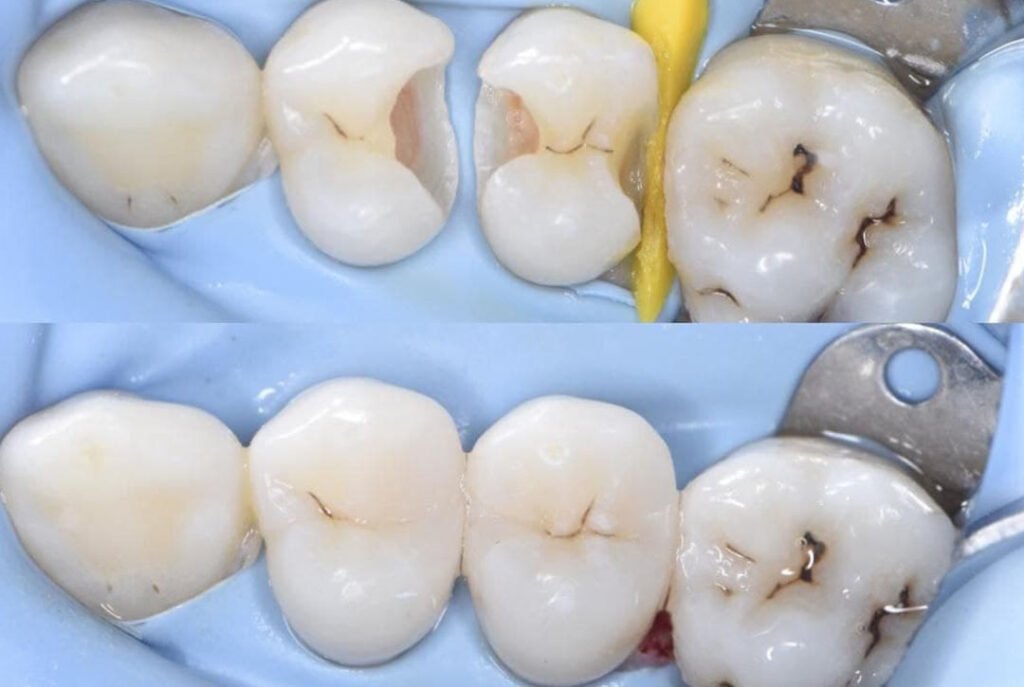
2. Why Can Large Fillings Make Teeth More Likely to Break?
This is particularly important with large MOD fillings—fillings that extend across the mesial, occlusal, and distal surfaces of a tooth.
I often explain this to my patients with a simple analogy.
Imagine you have two separate walls, and there is a force constantly trying to push between them.
Eventually, one of those walls can crack.
The same principle can apply to a tooth. When a large amount of the central tooth structure has been replaced by a filling, the remaining walls or cusps may become more vulnerable to the forces generated during chewing and, especially, grinding.
In these situations, simply replacing the filling with another filling may not provide the protection the tooth needs.
Sometimes the better solution is to cover and protect the remaining tooth structure.
Does every large filling need a crown?
No.
If a tooth has a large restoration, I look at the thickness and condition of the remaining walls, the amount of healthy tooth structure, the bite, and other clinical factors before deciding what type of restoration is appropriate.
The goal is not to put a crown on every heavily restored tooth.
The goal is to provide the right amount of protection for the tooth that remains.
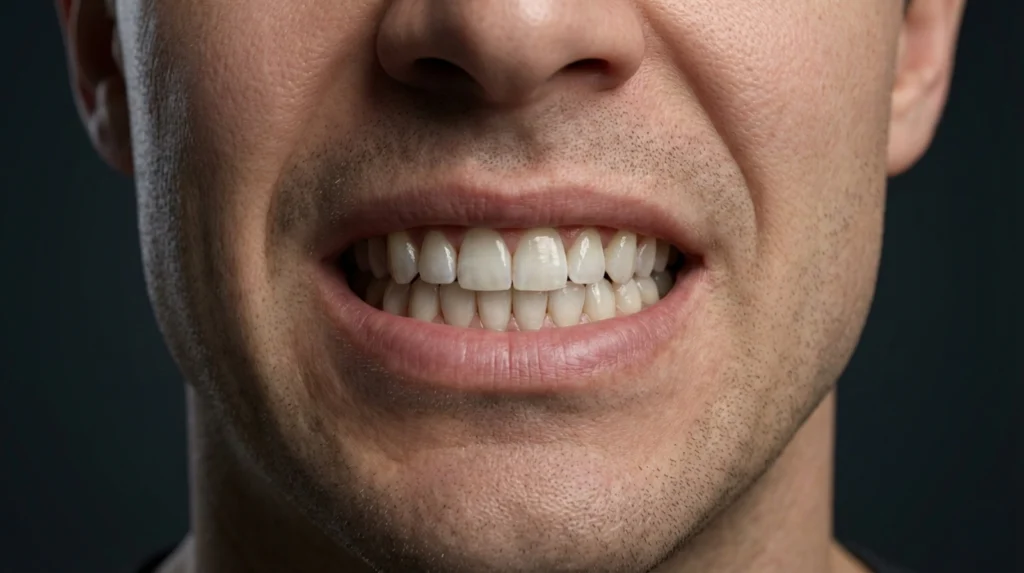
3. Bruxism Is a Major Cause of Broken Teeth
Bruxism—grinding or clenching your teeth—is one of the most common reasons I see teeth repeatedly breaking.
The problem isn’t necessarily one strong bite.
It is the repeated forces, sometimes occurring for hours, that can gradually weaken and damage the teeth.
A patient may have a tooth repaired perfectly, but if they continue applying excessive forces to it every night, the restoration or the tooth itself can eventually fail again.
That’s why repairing the broken tooth is only part of the treatment.
We also need to address the forces that caused the fracture.
My approach is first to identify and work on the patient’s habits and contributing factors. In selected situations, supportive measures such as magnesium may be considered.
If the problem persists or the patient needs additional protection, a properly designed night guard may be recommended.
The principle is simple:
If you don’t control the cause, you may keep repairing the same problem.
4. Root Canal–Treated Teeth Can Be More Vulnerable to Fracture
A tooth that has undergone root canal treatment can have a higher risk of fracture, particularly when a significant amount of its natural structure has already been lost.
A root canal removes the dental pulp, which means the tooth no longer has the same internal hydration and flexibility associated with a vital tooth.
But there is an important point here:
The loss of tooth structure is a major factor in the fracture risk.
A root-canal-treated tooth with minimal structural loss is very different from a tooth that has undergone extensive decay, a large MOD restoration, and root canal treatment.
When I have a root-canal-treated tooth with a large MOD restoration and significant structural loss, I generally want to cover the tooth and protect it rather than leave the remaining walls exposed to heavy forces.
The exact restoration depends on the individual tooth and how much healthy structure remains.
5. Cracks Can Cause Teeth to Break
Not every crack has the same meaning.
When a tooth is cracked, I need to determine the direction, location, depth, and extent of the crack before deciding what to do.
A crack that is confined to a restorable portion of the tooth may be managed differently from a crack that extends vertically below the gum.
A vertical crack extending below the gum or into the root can have a very poor prognosis and may make the tooth unrestorable.
A horizontal fracture, on the other hand, does not automatically mean that the tooth must be extracted.
So if your dentist tells you that you have a “crack,” the next question should be:
What type of crack is it, and how far does it extend?
The word “crack” by itself does not tell us the prognosis.
6. Acid Erosion and Enamel Wear Can Weaken Teeth
Teeth can also become progressively weaker because of enamel loss.
Acid erosion can gradually dissolve enamel, while bruxism and other mechanical forces can contribute to tooth wear.
As the protective enamel becomes thinner, more of the underlying dentin may become exposed.
This doesn’t necessarily cause the tooth to break immediately. But over time, significant structural loss can make teeth more vulnerable to fracture.
This is why it is important to identify the cause of tooth wear before simply restoring the damaged areas.
If the patient continues grinding or exposing the teeth to excessive acid, even a beautiful restoration may eventually fail.
7. Previous Dental Work Can Contribute to Fractures
A tooth that has already been heavily restored may have less natural structure remaining.
Old fillings, crowns, or other restorations may also develop defects, wear, or problems with their fit over time.
When a tooth breaks around an existing restoration, I don’t only look at the broken piece.
I evaluate the entire tooth:
- How much healthy structure remains?
- Is there decay underneath?
- Are the walls thick enough?
- Is there a crack?
- What is the condition of the existing restoration?
- How is the tooth functioning in the patient’s bite?
- Is the patient grinding or clenching?
- Has the tooth had a root canal?
- Is the periodontal support healthy?
Only after answering these questions can we decide what the tooth actually needs.
How Do I Know If a Broken Tooth Can Be Saved?
A broken tooth is not automatically a tooth that needs to be extracted.
The prognosis depends on several factors.
I look at the amount of remaining healthy tooth structure, the location and extent of the fracture, the condition of the pulp, the periodontal support, the presence of decay, the patient’s bite, and whether the tooth can be predictably restored.
One of the most important questions is:
Can we create a restoration that has enough healthy tooth structure to support it and provide a good long-term prognosis?
If the answer is yes, preserving the natural tooth is often possible.
If the fracture extends into an area that makes the tooth unrestorable, extraction may unfortunately be necessary.
Does Every Broken Tooth Need a Crown?
No.
This is where individualized treatment becomes important.
Depending on the tooth and the amount of remaining structure, treatment may involve:
Composite restoration
Appropriate for selected teeth with limited structural loss.
Onlay or overlay
These can provide cuspal protection while preserving more natural tooth structure than a full crown in appropriate cases.
Full crown
A crown may be indicated when the tooth has lost substantial structure and requires more comprehensive protection.
The decision should be based on the condition of the tooth, not simply on the fact that something broke.
For example, if a root-canal-treated tooth has a large MOD restoration and the remaining walls are significantly compromised, I would generally favor covering the tooth.
For a vital tooth, however, I first assess the thickness and quality of the remaining walls before deciding how much coverage is necessary.
More treatment does not automatically mean better treatment.
Why Do My Teeth Keep Breaking in the Same Place?
If the same tooth keeps breaking, there may be an underlying structural or functional problem.
Possible reasons include:
- The tooth has lost too much natural structure.
- There is a large existing restoration.
- The tooth has an undiagnosed crack.
- The patient has untreated bruxism.
- The restoration does not adequately protect the tooth.
- There is recurrent decay.
- The tooth has undergone root canal treatment.
- The bite is placing excessive forces on that tooth.
Simply repairing the broken area repeatedly may not solve the problem.
At some point, we need to step back and ask:
Why does this tooth keep breaking?
How Can I Prevent My Teeth From Breaking?
The best treatment for a broken tooth is often prevention.
Some of the most important steps include:
Treat cavities early
The more tooth structure that is lost to decay, the harder it becomes to restore the tooth conservatively.
Protect heavily restored teeth when indicated
A tooth with significant structural loss may need cuspal coverage rather than another large filling.
Control bruxism
If you grind or clench, addressing those forces is essential for protecting both your natural teeth and dental restorations.
Avoid chewing very hard objects
Teeth are designed for chewing food—not opening packages, biting pens, or breaking very hard objects.
Don’t ignore small fractures
A small chip or crack can sometimes be an early warning that a tooth is under excessive stress.
Have regular dental examinations
Early detection of decay, cracks, worn restorations, and excessive tooth wear can allow us to intervene before a major fracture occurs.
What Should I Do If My Tooth Breaks?
If a piece of your tooth breaks, don’t panic—but don’t ignore it either.
Try to avoid chewing on that side until the tooth has been evaluated.
If possible, keep the broken fragment and bring it with you to your appointment.
Your dentist will need to determine whether the fracture is limited to the tooth’s outer structure or whether it extends deeper.
The sooner the tooth is evaluated, the more options may be available for preserving it.
Frequently Asked Questions
Why do my teeth keep breaking?
Repeated tooth fractures can be caused by bruxism, cavities, large fillings, cracks, enamel wear, acid erosion, root canal treatment, or previous restorations. The cause needs to be identified before choosing treatment.
Can a tooth break because of a large filling?
Yes. Large fillings can leave the remaining walls or cusps of a tooth thinner and more vulnerable to biting forces, particularly when combined with bruxism.
Does every broken tooth need a crown?
No. Depending on how much healthy tooth structure remains, a tooth may be treated with composite, an onlay/overlay, or a crown. The treatment should be based on the individual tooth.
Does a root canal make a tooth more likely to break?
Root-canal-treated teeth can be more susceptible to fracture, particularly when substantial tooth structure has been lost. The absence of the pulp also means changes in hydration and flexibility, but the amount of remaining natural tooth structure is a major factor.
If my tooth is cracked, does it need to be extracted?
Not necessarily. It depends on the type, direction, depth, and location of the crack. A vertical crack extending below the gum can have a poor prognosis, while other fractures may be restorable.
Can bruxism cause teeth to break?
Yes. Repeated grinding and clenching forces can contribute to enamel wear, cracks, fractures, and restoration failure.
Why does my tooth keep breaking after I have it repaired?
If the underlying cause is not addressed, the tooth can remain vulnerable. For example, a patient with severe bruxism may continue breaking restorations unless the excessive forces are also managed.
How can I protect my teeth from breaking?
Treat cavities early, protect structurally weakened teeth when indicated, manage bruxism, avoid very hard objects and foods when appropriate, and maintain regular dental examinations.
Final Thoughts
When a tooth breaks, it is tempting to focus only on replacing the piece that was lost.
But a broken tooth is often telling us something.
Maybe there is a large filling that has left the remaining walls vulnerable. Maybe the patient is grinding every night. Maybe there is decay, a crack, significant tooth wear, or a history of root canal treatment.
When a tooth keeps breaking, don’t just keep repairing the broken piece. Find out why it is breaking.
The goal is to preserve as much healthy natural tooth structure as possible while providing enough protection for the tooth to function long term.
Sometimes that means a filling. Sometimes an onlay or overlay. Sometimes a crown.
And sometimes, unfortunately, the tooth cannot be predictably saved.
The important thing is that the treatment should come after the diagnosis, not before it.
Don’t just fix the fracture. Fix the reason behind it.